Capitals Wire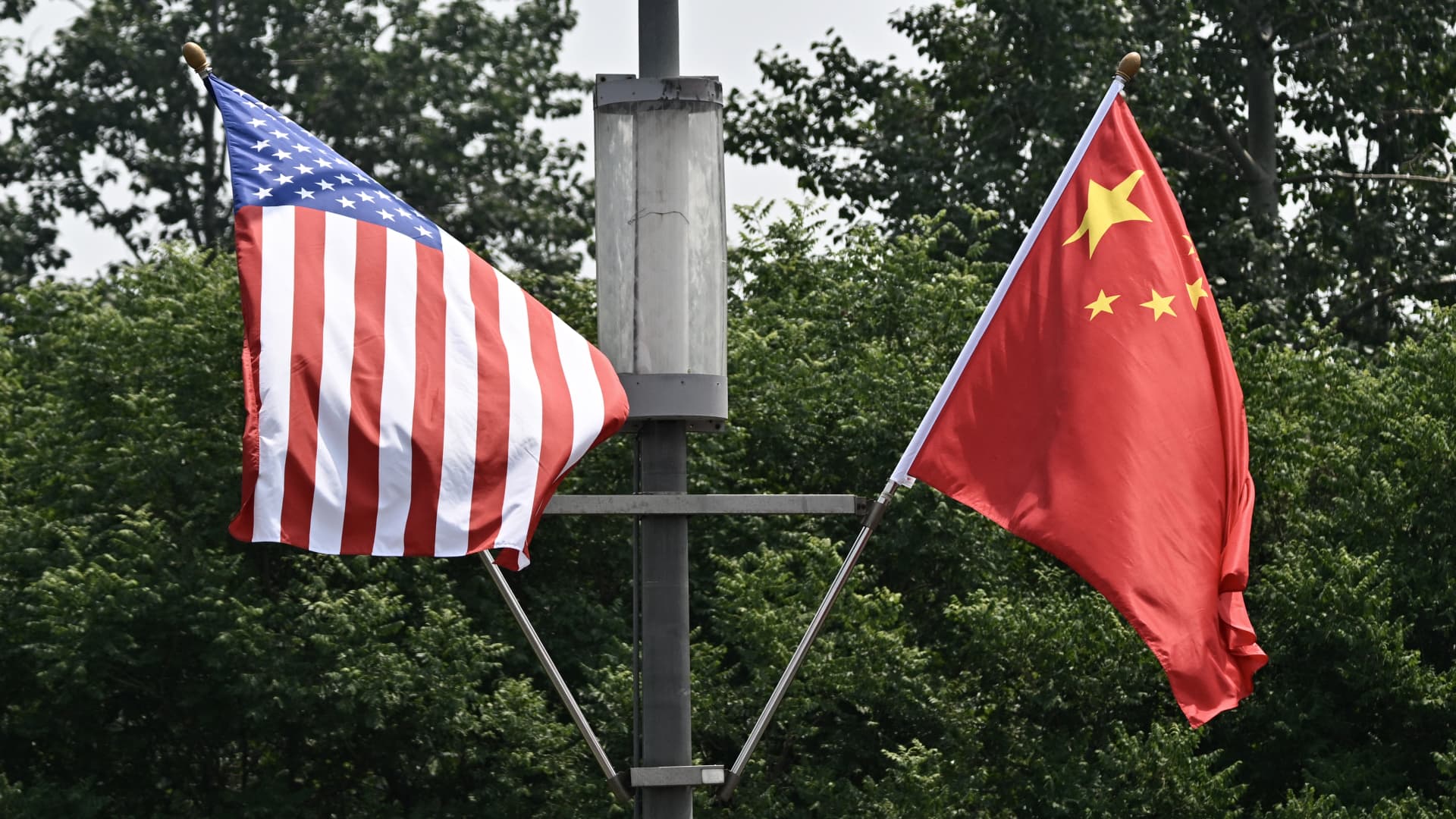
This report is from this week's The Tech Download newsletter. Like what you see? You can subscribe here.
It's the morning after the night before, as the U.S. President Donald Trump hosted Chinese President Xi Jinping in a historic state dinner. Fricassée, sea bass and crémeux were all on the menu, as presumably, was a whole lot of chatter about AI.
Seated with the U.S. and Chinese presidential couples were Nvidia's Jensen Huang and his wife Lori Huang, SpaceX CEO Elon Musk and AMD's Lisa Su, as well as Apple's Tim Cook. OpenAI CEO Sam Altman and president Greg Brockman, Google cofounder Sergey Brin and Microsoft boss Satya Nadella were also all on the guest list. Warnings around the existential risks of AI reaching fever pitch in recent weeks have pushed AI to the top of the global geopolitical agenda.
Trump posted to Truth Social ahead of his and Xi's head-to-head. "Super Intelligence (SI) will be a big topic of discussion, but I want to leave it exactly where it is. That is China's position also," he wrote Thursday morning, using the term he recently adopted instead of AI.
So what did they actually discuss? The national flags of the United States and China hang on a highway in Beijing on May 13, 2026, ahead of a visit by US President Donald Trump. (Photo by Pedro PARDO / AFP via Getty Images) Pedro Pardo | Afp | Getty Images China pushes AI cooperation A Chinese readout of the meeting said President Xi pointed out that China and the U.S. "may have competition, but they may cooperate even more " in AI.
"The two sides can continue their dialogue on AI, exchange views on its risks and benefits, and jointly prevent the misuse and abuse of AI," Xi said, per the readout. "AI must be kept under human control. A people-centered approach should be upheld, and AI should be developed for the positive and for good, so that AI will serve the progress of humanity." Trump, the Chinese readout stated, said the two sides should "maintain dialogue and strengthen cooperation on AI." The U.S. government had not issued its own readout of the summit as we went live.
Those references to cooperation come after U.S. Treasury Secretary Scott Bessent discussed a "U.S.-China AI dialogue" with his Chinese counterpart, He Lifeng, over the weekend, including a channel for incidents "up to a national security level." That has been compared to the Cold War era "red phone" — a direct channel between the U.S. and Russia designed to prevent a nuclear crisis escalating. Both U.S. and Chinese administrations had already shot down the idea of guardrails or a slowdown in developing the tech, which Altman and Anthropic's Dario Amodei had called for, alongside a number of their companies' researchers.
Flashpoints While more details about the meeting are expected to be released in the days to come, specifics are scant so far. "It appears we ended up with an intent to continue dialogue, along with a hotline of some sort for emergencies," Aalok Mehta, director of the Wadhwani AI Center at the Center for Strategic and International Studies, told CNBC. While the China camp's post-meeting readout sounds friendly, there were a number of flashpoints that could've made for a tense conversation.
U.S. export controls that restrict China's ability to import advanced Nvidia chips were set to remain a sticking point. Though, as CNBC reported on Wednesday, recent new chip releases and AI models from Chinese tech giants sharpen Beijing's case that Washington's restrictions have their limits. Friction could also have come from Chinese companies' reported remote access to Nvidia chips, via overseas data centers, and American claims of "distillation." Time will tell if any progress was made on those issues.
And if it was, there's no guarantee if either side will reveal any specific commitments. But ongoing discussions could lead to agreements around AI with more substance, said Mehta. "The hotline itself could become a robust tool when paired with a proper incident reporting system.
But that will take real commitment to making it work and high-level engagement from both sides." News edit An OpenAI agent gained unauthorized access to an Australian government website, Prime Minister Anthony Albanese said , raising fresh questions about the risks posed by increasingly autonomous systems. Anthropic and OpenAI on Tuesday each announced new, less costly AI models as both frontier labs continue to face stiff competition from cheaper, open-weight competitors. AMD stock surged 10% on Monday, pushing shares to a record high and topping a $1 trillion market cap benchmark for the first time.
Qualcomm unveiled its newest Android phone chipsets, which will be tuned for on-device AI and will compete with Apple's A20 Pro in iPhones. OpenAI on Monday posted a set of proposals for AI safety with a heavy focus on alignment research and a computing technique known as recursive self-improvement, or RSI. One more thing And lastly, we leave you with a hot take from an esteemed colleague.
Senior tech correspondent Arjun Kharpal had this to say on Meta's Muse agent: Meta's Muse is more of a challenge to Google than OpenAI and Anthropic. The consumer AI market is still up for grabs and the biggest players are going to be those that can produce a useful agent, the type that companies have promised. Plus, they'll need to earn the trust of users, especially as we have had all of these cybersecurity incidents recently.
Google has all the ingredients to have done this first — control of a mobile operating system in Android, search dominance, a plethora of apps from email to maps. All of that should have allowed it to create a useful agent with Gemini that could potentially be powerful on Android devices, which make up the majority of the world's smartphones. But Meta has beaten it to the punch.
That's not to say Google is down and out, but Meta has certainly laid down the gauntlet. To some extent, Meta is also challenging Apple to come up with something strong with Siri to ensure the Cupertino giant can leverage its massive install base of iOS users. Over and out.
Source: CNBC