Capitals Wire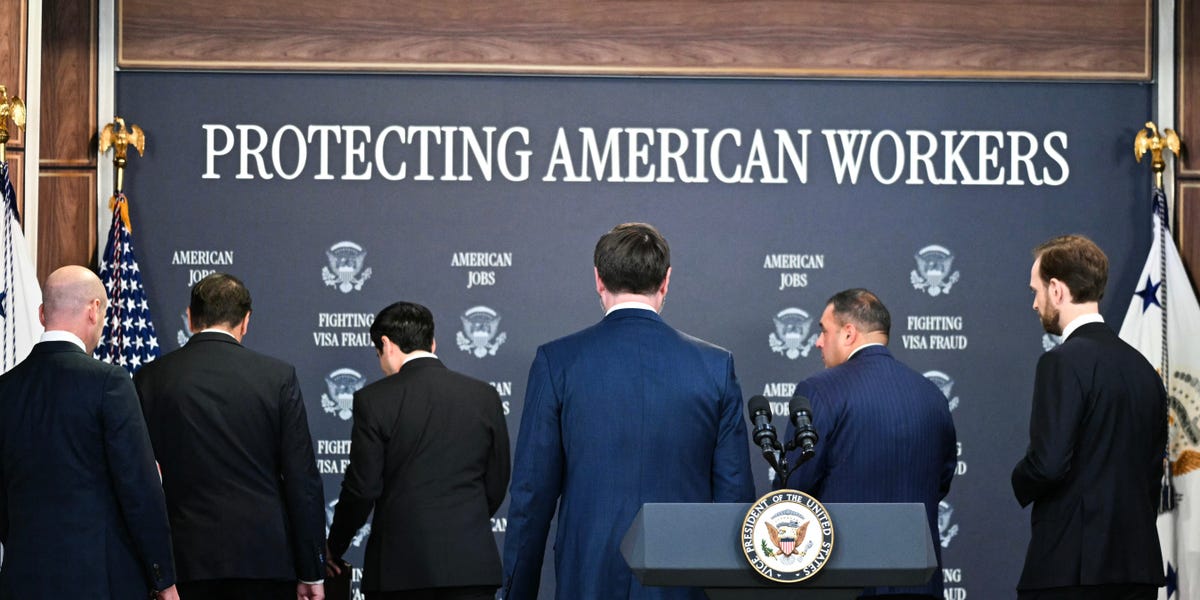
By Shubhangi Goel You're currently following this author! Click to unsubscribe from email alerts. The move has renewed debate over whether stricter skilled-immigration policies protect American workers or hurt American businesses.
Alex Wroblewski / AFP via Getty Images For foreign workers at some of the biggest employers in tech, there's another twist in an already uncertain system. The Trump administration’s decision to suspend Microsoft, Adobe, and other named tech companies from the Permanent Labor Certification, or PERM, program has renewed debate over whether stricter skilled-immigration policies protect American workers or hurt American businesses. On Thursday morning, Vice President JD Vance announced the suspension at a press conference.
He singled out Microsoft , saying: "If you do the math, for every worker that Microsoft laid off, they replaced that worker with one and a half foreign indentured servants." PERM is not itself a visa. It is the Labor Department certification employers generally need before sponsoring a worker for an employment-based green card. Vance said that some companies had abused the system and used foreign workers to undercut Americans.
In a statement on Thursday, Microsoft disputed Vance's accusations, saying most of its H-1B filings were for existing employees rather than new hires. "Of the approximately 6,000 H-1B visa applications we submitted in the last fiscal year, 80% percent were to extend or change the status of existing Microsoft employees. These were not to hire new people," the company wrote.
Besides Microsoft and Adobe, the action also affected six major IT services companies with deep ties to India’s tech sector: Tata Consultancy Services, Infosys, Wipro, HCLTech, Cognizant, and Capgemini. Here’s what immigration-policy experts and Indian tech voices are saying: Ron Hira, Howard University political science professor Hira, a Howard University political science professor and a longtime critic of the H-1B program, called the move against Microsoft “very significant.” Hira has long argued that employers can use the program in ways that depress pay and disadvantage US workers. He told the Associated Press on Thursday that there are supposed to be protections requiring employers to show that hiring an H-1B worker does not hurt similarly employed Americans.
“That’s never been enforced,” Hira said. Doug Rand, former senior advisor at US Citizenship and Immigration Services Rand, a former senior advisor at US Citizenship and Immigration Services during the Biden administration, took the opposite view. He called Vance’s announcement “incoherent” in a statement to AP.
Rand’s argument is that the policy could worsen the problem Vance says he wants to solve. H-1B workers are generally tied to their employers for their immigration status. A green card gives workers far more freedom to switch jobs and bargain over pay.
“If the Trump administration were truly concerned that H-1B workers are ‘indentured servants,’ then the last thing they would do is block companies from helping their own H-1B workers get green cards,” Rand told AP. Dinesh Pai, Indian tech founder Pai, an India-based vice president of investments at the country's largest brokerage Zerodha, reacted to what a more restrictive US path to permanent residency could mean for India. In a statement on X, Pai wrote that the immediate downside could be fewer high-earning Indians in the US, which in turn could mean lower remittances, less soft power, and less angel investments flowing back into Indian startups.
He also noted that India receives roughly $125 billion in annual remittances, with the US accounting for about a quarter of that total. But he also saw a potential upside. If US companies cannot bring talent to America, he wrote, “they probably will bring the work to India.” US visa uncertainty may also keep more top engineers in India to build domestic companies and AI startups, he added.
Nasscom, India’s IT-industry trade group Nasscom, India's main tech industry group, said immigration policy and skilled-talent mobility should be treated as separate issues. "While the decision affects a specific immigration pathway, Nasscom has consistently maintained that immigration and skilled talent mobility are two distinct issues and should not be viewed through the same lens," the group said in a statement to local media It also said the number of employees moving from H-1B status to permanent residency through PERM is “relatively limited.” Read next Shubhangi Goel You're currently following this author! Click to unsubscribe from email alerts.
Shuby is a senior reporter at Business Insider's Singapore bureau, where she writes about tech, with a focus on AI training and vibe-coding startups.She previously interned for Bloomberg News and CNBC. She studied communications and business at the National University of Singapore. In 2026, she won the Singapore Press Club Tech Journalism Award for her work on the hidden human cost of Meta's chatbot training program and an exposé on the black market for AI gig-work accounts.Have a tip?
Contact her via email at sgoel@insider.com or on secure messaging app Signal at @shuby.85. We can keep sources anonymous. Microsoft Immigration
Source: Business Insider